Unlock the potential of sandy soils
by Felicity Harrop Soil CRC Adoption Manager Sandy soils cover vast areas of Australia’s agricultural land, the Australian Soil Classification has an entire classification for
Soil health is a concept we can all identify with. It resonates with farmers, gardeners and land stewards alike. But as a scientific term, it’s more difficult to define.
Too often, soil health is used as a proxy for fertility – which it is not – or soil biology – which it also is not. In truth, soil health is a nebulous concept! It is, however, a powerful entry point for sparking curiosity and encouraging deeper understanding of how soils function and why soils matter.
There is still much conjecture about how to define soil health. For example, what is a ‘healthy’ soil? A soil that’s unsuitable for agriculture or horticulture is not necessarily ‘unhealthy’.
On the flip side, a soil that’s producing a successful crop or pasture could, in fact, be biologically or structurally degraded.
This complexity is why soil health continues to spark debate and why it’s so important to approach it thoughtfully.
That’s why you won’t see a ‘soil health’ section in the Smart Soils Resource Library – because all aspects of the Resource Library pertain to soil health, in one way or another.
Check out the Resource Library now.
Even though it may be hard to pin down scientifically, the concept behind soil health remains valuable. Degraded soils have reduced capacity to provide the ecosystem services we take for granted. This threatens food security, biodiversity and water quality.
A healthy soil will:
We may not all agree on a precise definition, but we can agree on this: soils matter and we must act to prevent its degradation.
Improving soil health is less about chasing a perfect definition and more about adopting smarter, systems-based approaches that make sense for your land and what you want to do with it.
Every soil is different. The key is observation, experimentation and ongoing learning. The Smart Soils Resource Library can assist you with that learning.
Smart Soils Resource Library: get practical guidance without the jargon.
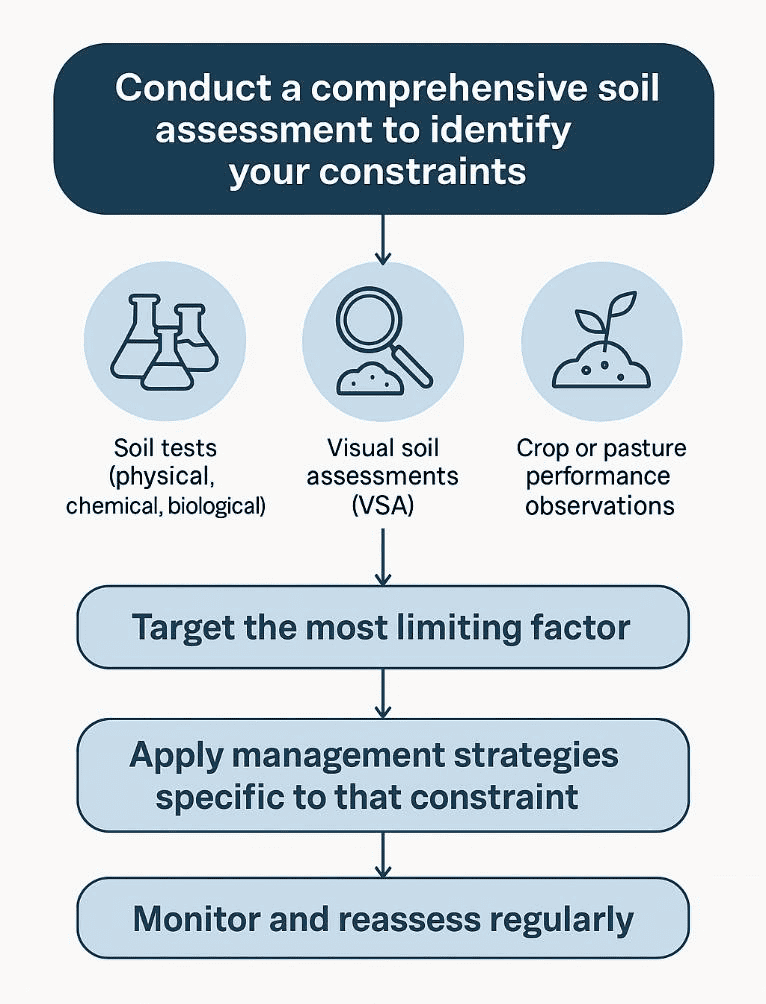
Where do you start? Soils are complex systems and knowing where to begin to improve them can be challenging.
Managing soil health isn’t about fixing everything at once. When multiple soil constraints exist – which is very common – it’s essential to have a systematic, evidence-based way to decide what to fix first. You’re not just choosing based on severity, but on impact, interactions and practicality.
The goal is to target the most limiting factor whatever your land use. It’s about identifying and addressing the most limiting constraint that if improved, will create the conditions for other subsequent improvements to work more effectively.
Identifying where you want to start is just the beginning. To find out more about specific soil issues and management techniques take look at the Smart Soils Resource Library.
If you want to talk to someone in your local area, the Smart Soils Get help in your region webpage provides contacts who can help.
The latest news and events for soil practitioners

by Felicity Harrop Soil CRC Adoption Manager Sandy soils cover vast areas of Australia’s agricultural land, the Australian Soil Classification has an entire classification for

Unpacking compaction in clay soils. Each month we review a resource from the Smart Soils Resource Library. This month’s resource is brought to you by Smart Soils Community of Practice

This Podcast Really Digs into the Big ASS Questions Each month we will be reviewing a resource from the Smart Soils Resource Library. This month’s