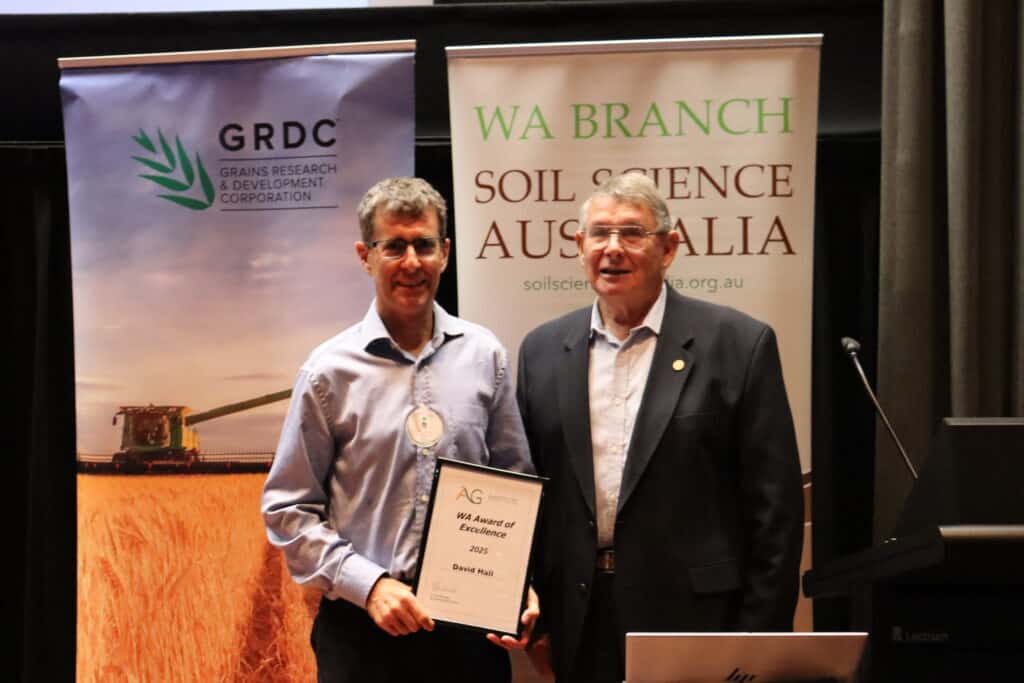
Don Burnside from the Ag Institute of Australia presented David with the WA Award of Excellence for his significant contribution to subsoil constraints in rural farming systems over his career.
On Friday 7th November, the WA soil community was brought together for the 2025 Boodja Lecture in Soil Science at the State Library of Western Australia for an evening of knowledge sharing, reflection and connection.
Hosted by Soil Science Australia’s WA Branch, the annual lecture continues the long practice of coming together to exchange ideas and experiences that deepen our understanding of soil science. WA Branch President George Mercer opened the event with an Acknowledgement of Country, noting the lecture’s ethos: “The Boodja Lecture strives to embody the practice of gathering, and the verbal sharing of soil knowledge and wisdom that connects us to the land”.
The Boodja Lecture was delivered by David Hall, Principal Research Scientist at DPIRD, who is soon to retire after more than forty years dedicated to understanding and improving Australia’s agricultural soils. In his presentation, “Beach sands and sodic clays: the role of soil science in transforming soils for crop production”, David shared the story of his career, beginning with his early research into irrigated systems and hardsetting soils in central New South Wales and later sandy soils and sodic clays along WA’s South Coast. Across these decades, he has focused on identifying the chemical and physical barriers that limit crop growth and has worked alongside growers to test practical solutions in the field.
During the lecture, David reflected on the remarkable transformation he has witnessed in the Esperance Port Zone. Crop production in the region has risen from under 600,000 tonnes in the early 1990s to more than 4 million tonnes today, driven largely by improved management rather than an expansion of cropping land. He walked the audience through the evolution of soil amelioration in WA over this time, including the adoption of minimum and no tillage, furrow seeding, claying, deep ripping, liming and deep-placed amendments. Precision agriculture has added another layer of progress, with GPS-based tramline systems and variable rate technology helping growers manage variability across large landscapes.
A central part of David’s talk was an explanation of the four-phase approach to tackling soil constraints that has guided much of his research. The process begins with identifying the constraint and understanding its severity, followed by modifying the soil profile to address the chemical or physical limitation so that soil biology can respond. He then emphasised the importance of assessing the impact of treatments on fertility, productivity and profitability and evaluating whether the benefits remain sustainable over multiple seasons. While this approach has yielded major gains on WA’s sandy soils, David noted that inland clay soils continue to face significant challenges, including sodicity, salinity and boron toxicity. These constraints affect root growth and nutrient uptake and can be compounded by a drying climate.
David closed his lecture by highlighting the importance of long term, field-based research and the collaboration between growers, agronomists, researchers and students that makes this work possible. “I feel that soil science will continue to be an inseparable part of my identity,” he reflected.
Following the lecture, Don Burnside from the Ag Institute of Australia presented David with the WA Award of Excellence in recognition of his outstanding contribution to addressing subsoil constraints and improving the productivity of rural farming systems over his career.
The WA Branch extends its thanks to GRDC for sponsoring the 2025 Boodja Lecture, as well as to the volunteers and partners who helped deliver the event. Members and guests were invited to continue the conversation over dinner following the lecture.
As one of many events delivered throughout the year by our state branches and national office, the Boodja Lecture is part of Soil Science Australia’s ongoing commitment to supporting members with professional learning and networking opportunities.
To keep informed on future events browse our upcoming event calendar.
For more perspectives on David’s lecture and career, see the media releases by:
Department of Primary Industries and Regional Development
Boodja Soil Science Lecture: Unearthing the keys to transform WA soil from ancient sands to productive land