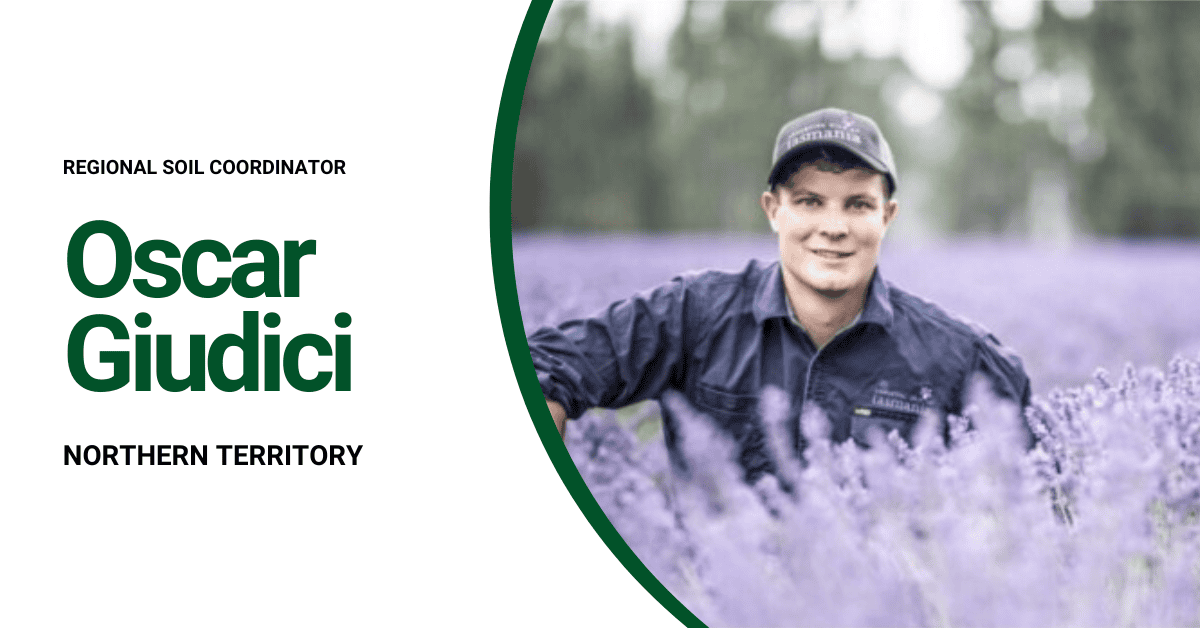
As a kid growing up in southern Tasmania, I believed soil was black, tasted alright, and that was about it. I remember visiting friends on a farm in the northwest of Tasmania and being alarmed that the dirt was red. I distinctly recall arguing with my friend that dirt was black and his red dirt was weird.
Fast forward several years, and I was looking at ploughed paddocks in the Tasmanian Midlands— a motley mix of colours and textures—zoning them for variable-rate application of water, lime, and fertiliser, and layering yield maps with acidity, salinity, and electrical conductivity data. My childhood self would have had a few things to say.
I was drawn to study agricultural science by the convergence of several interests: a strong curiosity for natural science, an inherited love of mapping from walking with Dad through the Huon forests with a GPS pack, an innate love of tractors, and exposure to the realities of food security and agronomy after a year in East Africa.
I chose to study agricultural science at the University of Tasmania, seeing it as a way to combine these interests.
Over the past 10 years since graduating, I have worked as an agronomist, farm manager, and irrigation technician across Tasmania’s horticultural sector and Darwin’s tropical horticulture. I have also worked on a pilot farming project in East Arnhem Land and in environmental rehabilitation in NSW’s Central West for a mining exploration company.
Alongside this practical experience, I am deeply interested in the broader challenges facing Australian agriculture. I am acutely aware of the pressures on the sector, including the decline in soil health and quality.
However, alongside these challenges are emerging opportunities with immense potential. New technologies have the capacity to reshape our production systems over the coming decades, with significant implications for soil management.
The challenges in the Northern Territory and northern Western Australia are compounded by scale, population, and isolation. The soils are generally less fertile than their southern counterparts and can degrade rapidly if not well managed. This inherent fragility creates a strong imperative to understand these systems, share knowledge on how to maintain them, and adopt proven practices as efficiently as possible.
I am excited to leverage relationships between industry, government, and the university to help streamline knowledge transfer and deliver opportunities where they are most needed. The challenges are real, but this is also a pivotal moment, and I look forward to contributing to meaningful and measurable improvements in the soil of Northern Australia.